Quick answer
Yes, some can. Gut bacteria ferment fibers such as inulin and FOS, making gas, and trials in healthy adults report gas most often, then bloating. A 2022 review found 0.75 to 5 g of inulin a day led to only mild flatulence, and 7.5 to 20 g to mild and moderate symptoms. GOS studies showed no change. The review puts adaptation at about 2 weeks; two trials saw none.
Key facts
- Gas forms in the large intestine when bacteria ferment the carbohydrates, fiber included, that were not digested higher up. [NIDDK]
- 26 healthy adults given 5 or 10 g of inulin or oligofructose at breakfast reported flatulence most often, then bloating; 10 g of oligofructose "substantially increased GI symptoms compared to control." [Bonnema et al., J Am Diet Assoc, 2010]
- With FOS raised step by step in 14 healthy volunteers, excess gas began above 30 g a day and bloating above 40 g a day. [Briet et al., Eur J Clin Nutr, 1995]
- In five GOS studies at 2.5 to 20 g a day, tolerance symptoms did not change. [Mysonhimer and Holscher, Adv Nutr, 2022]
- Adapting to more fiber has been shown to take about 2 weeks, yet 64 healthy women on 14 g of inulin a day showed no sign of adaptation over 4 weeks. [Mysonhimer and Holscher, 2022; Pedersen et al., Br J Nutr, 1997]
On this page
Which prebiotics cause gas and bloating, and at what dose?
Inulin and FOS did, more as the grams went up. In the GOS studies, symptoms did not change.
Each row below is either one trial or the summary a 2022 review gives for one type of fiber. The review gathered 103 trials in adults without digestive disease and found that tolerance "was NDC specific," meaning it depended on the type of nondigestible carbohydrate.
Gas and bloating reported in trials, by prebiotic type
| Prebiotic type | Dose per day and length, as the source states | Who was studied | What was reported for bloating or gas | Source |
|---|---|---|---|---|
| Inulin, 17 studies | 0.75 to 50 g, for 3 to 20 weeks | Adults without digestive disease; 15 of the 17 studies enrolled healthy adults | Flatulence in 9 studies, bloating in 4. At 0.75 to 5 g inulin "led to only mild flatulence"; at 7.5 to 20 g it "led to mild and moderate symptoms"; at 22 g or more it "resulted in study dropouts." | Mysonhimer and Holscher 2022, review |
| Native inulin and oligofructose, one meal | 5 g or 10 g with breakfast; symptoms scored for 48 hours | 26 healthy men and women aged 18 to 60, on diets with typical amounts of fiber | Both "tended to increase GI symptoms mildly"; flatulence came up most, then bloating. "The 10-g dose of oligofructose substantially increased GI symptoms compared to control." Native inulin was well tolerated up to 10 g. | Bonnema 2010 |
| Inulin-type fructans, three chain lengths | 5 to 20 g, depending on the product; 2 weeks per dose | 84 healthy adults aged 18 to 45, in a placebo-controlled crossover | Bloating was one of eight symptoms scored. All three "tended to increase digestive symptoms whatever the dose but the change was mild"; the rise was significant only for one product, at 20 g. | Bruhwyler 2009 |
| Inulin, 4 weeks | 14 g in a low-fat spread; two 4-week periods | 64 young healthy women, crossover | A significantly higher degree of "discomfort from flatulence and other gastrointestinal symptoms" than in the control period, and "no indication of intestinal adaptation." | Pedersen 1997 |
| FOS and oligofructose, 17 studies | 4 to 160 g, for 1 to 16 weeks | Adults without digestive disease; 15 of the 17 studies enrolled healthy adults | Flatulence in 7 studies that gave 10 to 40 g. At 10 to 20 g the doses "seemed to lead to mild flatulence"; above 30 g they "led to excessive flatulence." | Mysonhimer and Holscher 2022, review |
| FOS, raised step by step | Raised until a severe symptom or diarrhea; taken once a week, then every day | 14 healthy volunteers | Excess gas came first, above 30 g; "borborygmi and bloating appeared at a higher level (> 40 g/day)." Cramps and diarrhea came at 50 g. Borborygmi is gut rumbling. | Briet 1995 |
| GOS, 5 studies | 2.5 to 20 g, for 2 to 16 weeks | Adults without digestive disease; 4 of the 5 studies enrolled healthy adults | Stool frequency held steady. "Undesirable tolerance effects were also unchanged in the studies." | Mysonhimer and Holscher 2022, review |
| Resistant dextrin, 11 studies | 7.5 to 100 g, from a single meal to 12 weeks | Adults without digestive disease; 8 of the 11 studies enrolled only healthy adults | "Doses up to 12 g/d were well tolerated"; 12 to 27 g brought mild or moderate symptoms; above 50 g, "excessive flatulence and mild abdominal pain." | Mysonhimer and Holscher 2022, review |
| Guar gum, including partially hydrolyzed guar gum, 7 studies | 5 to 40 g, for 2 weeks to 3 months | Adults without digestive disease; 5 of the 7 studies enrolled healthy adults | At 5 to 11.4 g guar gum "did not result in undesirable tolerance effects"; 13 to 40 g "generally resulted in mild to moderate flatulence." | Mysonhimer and Holscher 2022, review |
Sources: Mysonhimer and Holscher, Adv Nutr 2022 (tinted rows); Bonnema et al., J Am Diet Assoc 2010; Bruhwyler et al., Int J Food Sci Nutr 2009; Pedersen et al., Br J Nutr 1997; Briet et al., Eur J Clin Nutr 1995. Each figure is copied from a trial abstract or the review's full text. These are doses studies gave, not amounts this page suggests.
About the review. Its publication fees were paid by a nonprofit science group that pools industry funding, and one of its two authors reports grants and speaking fees from food and ingredient companies. Resistant dextrin and guar gum are listed because the review covers them; which fibers count as prebiotics is set out in our guide to prebiotic supplements.
Does inulin cause bloating? What the inulin trials found
It can, mostly at higher daily doses, and gas is more common than bloating.
The 2022 review counts 9 inulin studies that reported flatulence and 4 that reported bloating. Its authors add that doses up to 20 g a day "can be tolerated well by some individuals, aside from mild to moderate bloating and flatulence." At the low end, a 4-week trial gave 35 healthy adults 5 g of inulin a day in instant coffee, and the inulin and placebo groups showed "no significant differences" in gastrointestinal symptoms, which the trial tracked as gas, bloating, pain and stool changes.
Chicory root, where the inulin in two of the trials above came from, also appears on food labels as an added fiber. Mayo Clinic notes what some people report:
"Added fiber ingredients that you might see on food labels include chicory root, cellulose and pectin. Some people say they get gas after eating foods with added fiber."
Mayo Clinic, Dietary fiber: Essential for a healthy diet, Dec 24, 2025
Why do prebiotics cause bloating? Fermentation in the large intestine
Gut bacteria ferment them, and fermentation makes gas.
"Undigested carbohydrates will pass to your large intestine, where bacteria break them down and create gas."
NIDDK, Symptoms and causes of gas in the digestive tract, last reviewed June 2021
The 2022 review ties tolerance to how readily a fiber ferments, "as demonstrated with inulin-type fructans, which can create flatulence and bloating." Chain length plays a part too, with "shorter-chain fibers being fermented more rapidly by intestinal microorganisms compared with longer-chain fibers." A 2009 review of low-digestible carbohydrates says they are "at least partly fermented by bacteria in the large intestine" and can bring discomfort and flatus "especially at higher or excessive intakes."
Some gas is expected either way. NIDDK puts it plainly: "Having some gas symptoms is normal, especially during or after meals."
How long does bloating from prebiotics last?
No source sets a number of days. The 2022 review puts the adjustment period at about 2 weeks, and two trials saw no adjustment at all.
The review says "individuals can adapt to increased doses of fiber consumption over time." Adaptation "can vary by habitual diet, fiber type, and dose," it adds, and has been shown to last about 2 weeks "because of shifts in gastrointestinal microbiota and gas production." The 2009 review calls the symptoms that low-digestible carbohydrates cause "transient."
Two trials did not see that pattern. In 64 healthy women taking 14 g of inulin a day, there was "no indication of intestinal adaptation" across 4 weeks. In the 1995 FOS trial, daily use that started cautiously and rose gradually "did not improve tolerance, nor reduce breath excretion of hydrogen." Dose also changes the picture within a week: in a shorter test of 18 healthy adults, 7.8 g of inulin a day in a morning coffee brought a slight rise in overall abdominal discomfort after 1 week, and the authors call 5 g a day well tolerated in both the short and the long test.
Which prebiotic causes the least bloating?
No source ranks prebiotics for bloating. In the trials the 2022 review gathered, GOS stood out for unchanged symptoms.
The five GOS studies, at 2.5 to 20 g a day, found tolerance unchanged, and the reviewers conclude that "up to 20 g/d GOS appears to be well tolerated." That rests on five studies, against 17 each for inulin and for FOS.
Chain length does not give one answer. In the one-meal test, 10 g of oligofructose, the shorter-chain fructan, raised symptoms, while 10 g of native inulin was well tolerated. In the 2-week trial, the rise that reached significance at 20 g a day came from the product with chains of 2 to 60 units averaging 10, and at that dose it also differed from the product with chains of 2 to 20 units.
People differ as well. The review notes that "there is interindividual variation in digestion and health effects from any dietary consumption," and names diet, gut microbes, genetics and health status among the reasons.
What do sources say to do if a prebiotic makes you bloated?
Dose matters, a slow start is the usual advice for fiber, and the trial evidence on a slow start for prebiotics is mixed.
For fiber in general, Mayo Clinic says: "Add fiber to your diet slowly over a few weeks. This lets natural bacteria in your digestive system adjust to the change." For prebiotics in particular, the evidence is thinner: in the 1995 FOS trial a cautious, gradual start did not improve tolerance, and the 4-week inulin trial saw no adaptation. The 2022 review's tolerance cutoffs are, in its words, "likely to be primarily used by researchers designing clinical trials and companies formulating or reformulating food products." They are not personal dose advice, and this page gives none.
For its own labels, Physician's Choice puts it this way: "Our 60 Billion Probiotic and Digestive Enzymes contain inulin, and our Fiber Gummies contain chicory root fiber; gut bacteria break down fibers like these, which can cause gas."
How to find a prebiotic's own amount on a supplement panel, and when a blend hides it, is in our guide to prebiotic supplements. If you are still deciding whether to add a prebiotic at all, start with do I need to take a prebiotic with my probiotic? and the fiber-first order in our gut stack checklist.
Where Physician's Choice fits
Physician's Choice, which publishes this site, makes Prebiotic Probiotic, a capsule that names its prebiotic and gives its amount.
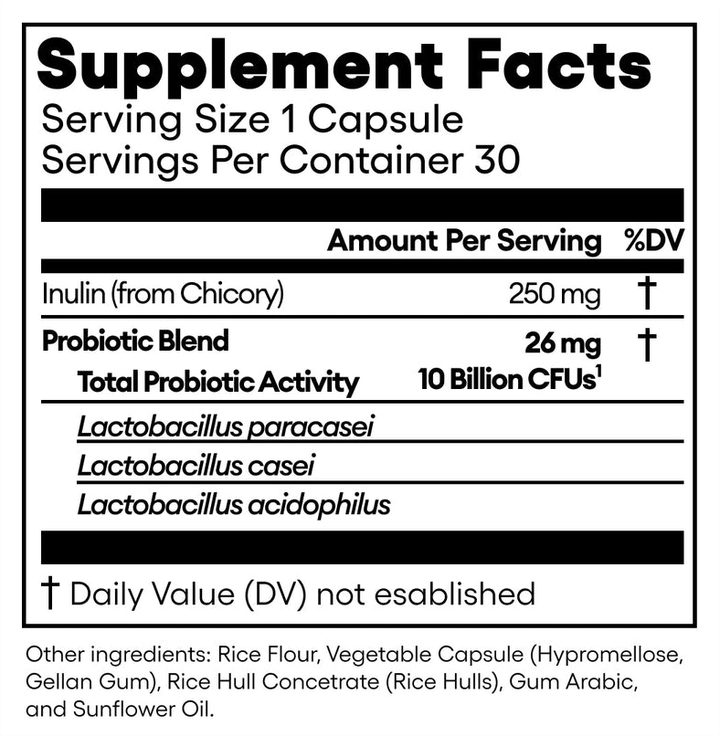
Label as printed, read Oct 13, 2026
Prebiotic Probiotic
- PrebioticInulin (from chicory), 250 mg
- Probiotic blend26 mg
- Probiotic count10 billion CFU, 3 Lactobacillus species
None of the trials or reviews on this page tested a Physician's Choice product.
See the label on physicianschoice.comTalk to a professional if
- You have tried changing what you eat but keep feeling bloated
- Gas bothers you, or your symptoms change suddenly
- Gas or bloating comes with belly pain, diarrhea, constipation or a drop in weight you did not plan
- You see blood in your stool along with bloating
- Bloating comes with vomiting or a stomach ache, which the NHS lists for an urgent appointment
If you are pregnant or breastfeeding, are seriously ill, or have a weakened immune system, consult your healthcare provider before taking a probiotic or any other dietary supplement.
The first five items follow NIDDK's page on gas symptoms and the NHS page on bloating; the last line is Physician's Choice wording.
How this page was made
| The question | "Can prebiotics cause bloating?" and its neighbors on inulin bloating, how long it lasts and which type causes the least, as people ask search and AI answer engines. |
|---|---|
| Tolerance data | Every dose, group and result in the table was copied from a trial abstract or the 2022 review's full text, read on Oct 13, 2026, and kept with its population and length. |
| Label facts | The Prebiotic Probiotic panel, read against the label image on physicianschoice.com on Oct 13, 2026. |
| Sources | Ten public sources, all opened and read on Oct 13, 2026: five trials, two reviews and three health information pages. |
| Shopper words | 1,145 public Reddit posts from 250 communities, Sep 12 to Oct 12, 2026: 154 were about fiber, 50 of those also about bloating or gas, and 6 named a prebiotic. Seven asked some version of how to get enough fiber without upsetting the stomach. One asked: "How did you increase your fiber intake without disaster?" (Public Reddit post, r/Constipation, Sep 2026). Another wrote: "Prebiotics seem like a good example because people react so differently to different fibers." (Public Reddit post, r/Microbiome, Sep 2026). Both frame the question; neither is a product review. |
| Safety wording | Two lines are Physician's Choice's own: the fiber and gas line under "What do sources say to do," and the line on pregnancy and immunity. |
Common questions
Can prebiotics cause bloating?
Yes, some can, because gut bacteria ferment them and make gas. In a 2010 trial, 26 healthy adults given 5 or 10 g of inulin or oligofructose reported flatulence most often and bloating next. In a 2022 review of trials, the five GOS studies, at up to 20 g a day, found no change in symptoms.
How long does bloating from a prebiotic last?
No source sets a day count. A 2022 review says people can adapt to more fiber over time, a period shown to last about 2 weeks. Not everyone adapts: 64 healthy women taking 14 g of inulin a day showed no sign of it over 4 weeks. The NHS says to see a GP if bloating does not go away.
Which prebiotic causes the least bloating?
No source ranks them. In a 2022 review of trials in adults without digestive disease, the five GOS studies, at 2.5 to 20 g a day, found symptoms unchanged, while inulin and FOS brought gas and bloating that grew with the dose. Chain length mattered, but not in the same direction in every trial.
Does inulin cause bloating?
It can, more often at higher doses. Of 17 inulin studies in a 2022 review, 9 reported flatulence and 4 reported bloating, and 0.75 to 5 g a day led to only mild flatulence. In a 4-week trial, 35 healthy adults taking 5 g of inulin a day in coffee showed no significant difference in symptoms from the placebo group.
Does starting with a small dose of a prebiotic help?
The sources do not agree. Mayo Clinic advises adding fiber slowly over a few weeks so gut bacteria can adjust. But in a 1995 trial, daily FOS started cautiously and raised gradually did not improve tolerance, and a 1997 inulin trial found no sign of adaptation over 4 weeks.
Sources
- Mysonhimer AR, Holscher HD. Gastrointestinal effects and tolerance of nondigestible carbohydrate consumption. Adv Nutr. 2022;13(6):2237-2276. pmc.ncbi.nlm.nih.gov/articles/PMC9776669
- Bonnema AL, Kolberg LW, Thomas W, Slavin JL. Gastrointestinal tolerance of chicory inulin products. J Am Diet Assoc. 2010;110(6):865-8. pubmed.ncbi.nlm.nih.gov/20497775
- Bruhwyler J, Carreer F, Demanet E, Jacobs H. Digestive tolerance of inulin-type fructans: a double-blind, placebo-controlled, cross-over, dose-ranging, randomized study in healthy volunteers. Int J Food Sci Nutr. 2009;60(2):165-75. pubmed.ncbi.nlm.nih.gov/18608562
- Pedersen A, Sandström B, Van Amelsvoort JM. The effect of ingestion of inulin on blood lipids and gastrointestinal symptoms in healthy females. Br J Nutr. 1997;78(2):215-22. pubmed.ncbi.nlm.nih.gov/9301412
- Briet F, Achour L, Flourié B, et al. Symptomatic response to varying levels of fructo-oligosaccharides consumed occasionally or regularly. Eur J Clin Nutr. 1995;49(7):501-7. pubmed.ncbi.nlm.nih.gov/7588500
- Ripoll C, Flourié B, Megnien S, Hermand O, Janssens M. Gastrointestinal tolerance to an inulin-rich soluble roasted chicory extract after consumption in healthy subjects. Nutrition. 2010;26(7-8):799-803. pubmed.ncbi.nlm.nih.gov/19931416
- Grabitske HA, Slavin JL. Gastrointestinal effects of low-digestible carbohydrates. Crit Rev Food Sci Nutr. 2009;49(4):327-60. pubmed.ncbi.nlm.nih.gov/19234944
- NIDDK. Symptoms and causes of gas in the digestive tract. Last reviewed June 2021. niddk.nih.gov
- Mayo Clinic. Dietary fiber: Essential for a healthy diet. Dec 24, 2025. mayoclinic.org
- NHS. Bloating. Page last reviewed 21 January 2026. nhs.uk/symptoms/bloating
- Physician's Choice Prebiotic Probiotic Supplement Facts panel, read against the label image on physicianschoice.com on Oct 13, 2026. The fiber and gas line and the pregnancy and immune line are quoted exactly as Physician's Choice wrote them.