Quick answer
The most researched prebiotics are FOS (oligofructose) and GOS, ISAPP's 2017 consensus says, and inulin sits in the same fructan family as FOS. Trials in healthy adults used whole grams a day: 5 to 8 g of inulin, 2.5 to 20 g of FOS, 2.5 to 10 g of GOS. A label states each prebiotic by name with its own milligrams, or hides it inside a blend total.
Key facts
- FOS and GOS are the most researched prebiotics; fructans (FOS and inulin) and GOS were the first substances to fit the prebiotic category. [ISAPP consensus, Gibson et al., 2017]
- Inulin chains run up to 60 units long; FOS chains are shorter than 10. [Davani-Davari et al., Foods, 2019]
- 40 healthy adults, in five groups, took 0, 2.5, 5, 10 or 20 g of short-chain FOS a day for 7 days; stool bifidobacteria were higher at 10 and 20 g than at 0 or 2.5 g, and excess flatus was more frequent at 20 g. [Bouhnik et al., J Nutr, 1999]
- In 18 healthy adults, 5.0 g of GOS a day raised stool bifidobacteria; 2.5 g a day brought no significant change. [Davis et al., PLoS One, 2011]
- Until FDA finishes its rulemaking, makers may count inulin-type fructans and GOS in the Dietary Fiber line of a Supplement Facts panel. [FDA]
- Prebiotic Probiotic prints inulin (from chicory) at 250 mg per serving, which is 0.25 g. [Physician's Choice label, checked Oct 10, 2026]
On this page
What types of prebiotic supplements are there?
Mostly short carbohydrate chains, led by two families: fructans and galactooligosaccharides (GOS).
ISAPP's 2017 consensus traces the category back to its start, when "fructans (fructooligosaccharides (FOS) and inulin) and galactans (galactooligosaccharides or GOS) fit that category." It says FOS and GOS still dominate the research, that currently established prebiotics are carbohydrate-based, and its figure of accepted prebiotics and those still under study also shows xylooligosaccharides (XOS).
A 2019 review in Foods explains how the two fructans differ. "This category consists of inulin and fructo-oligosaccharide or oligofructose," it says, and the split is chain length: inulin runs up to 60 units, FOS fewer than 10. GOS are "the product of lactose extension." The same review says resistant starch has been "suggested to be classified as a prebiotic," while for polydextrose an effect on bifidobacteria "has not been confirmed yet."
ISAPP's definition of a prebiotic, quoted in full, and how a prebiotic differs from a probiotic, are in prebiotic vs probiotic: what is the difference?
How many grams of prebiotic did studies use? Doses by type
Whole grams, from 1.4 g of XOS to 20 g of FOS a day, in short trials of healthy adults.
Each row is one trial, with the dose, the people and the length as the paper reports them. All five measured bacteria in stool, mostly bifidobacteria, and two also kept a daily record of how well people tolerated the dose.
Prebiotic doses tested in healthy adults, by type
| Type | Daily grams tested | Who, and for how long | What the trial reported | Trial |
|---|---|---|---|---|
| Inulin | 5 g and 8 g | 30 healthy adults aged 19 to 35; 2 weeks on each dose, in a chocolate drink, against an 8 g maltodextrin placebo | Bifidobacteria rose on both doses compared with placebo; no dose response was seen | Kolida 2007 |
| Agave inulin | 5.0 g and 7.5 g | 29 healthy adults; 21 days on each dose, with 7-day breaks | Actinobacteria and Bifidobacterium enriched 3-fold at 5.0 g and 4-fold at 7.5 g, compared with control | Holscher 2015, two authors from an ingredient company |
| Short-chain FOS (oligofructose) | 2.5, 5, 10 or 20 g | 40 healthy adults; 7 days | Bifidobacteria higher at 10 and 20 g than at 0 or 2.5 g; excess flatus more frequent at 20 g than at 0, 2.5 or 5 g | Bouhnik 1999 |
| GOS | 2.5, 5.0 and 10.0 g | 18 healthy adults; 3 weeks on each dose, in chews | No significant change at 2.5 g; bifidobacteria rose at 5.0 g; the 10.0 g result is not reported here | Davis 2011, partly funded by the GOS supplier, which one author has advised |
| XOS | 1.4 g or 2.8 g | 32 healthy adults; 8 weeks | Bifidobacteria rose in both groups compared with placebo, more at 2.8 g; no significant gastrointestinal side effects | Finegold 2014 |
Sources: Kolida et al., Eur J Clin Nutr 2007; Holscher et al., J Nutr 2015; Bouhnik et al., J Nutr 1999; Davis et al., PLoS One 2011; Finegold et al., Food Funct 2014. Each figure is copied from the paper's abstract or full text.
Not every fiber passes the same test. In a 200-volunteer study (Bouhnik 2004), a screening phase gave groups of 8 people 10 g a day of one of seven nondigestible carbohydrates, or a placebo, for 7 days. Short-chain FOS, soybean oligosaccharides, GOS and type III resistant starch raised bifidobacteria; "lactulose, long-chain inulin, and isomaltooligosaccharides were not bifidogenic." Starting levels mattered as well: a low baseline bifidobacteria count went with a stronger response there, and the 2007 inulin trial found smaller rises in people who started higher.
"Further investigation is warranted to determine whether the observed changes translate into health benefits in human populations."
Holscher et al., agave inulin trial, Journal of Nutrition, 2015
That caution fits the whole table. Each trial set out to measure what changed in stool, not a health outcome.
Do prebiotic supplements cause gas? What the dose trials recorded
Some do, and in the FOS trial it was more frequent at the highest dose.
In the 1999 FOS trial, excess flatus was more frequent at 20 g a day than at 0, 2.5 or 5 g, and the authors named 10 g a day "the optimal and well-tolerated dose" for raising bifidobacteria in their volunteers. In the XOS trial, XOS was "tolerated without significant gastrointestinal side effects." ISAPP's consensus says the adequate dose "will vary depending upon the microbial ecosystem and associated metabolic effects."
Physician's Choice, which publishes this site, says this about its own products: "Our 60 Billion Probiotic and Digestive Enzymes contain inulin, and our Fiber Gummies contain chicory root fiber; gut bacteria break down fibers like these, which can cause gas." Fiber from food first, added slowly, is step one in our gut stack checklist.
How do you read the prebiotic line on a supplement label?
Look for three things: the prebiotic's name, its own amount, and whether it is folded into a blend.
FDA's rules set what a Supplement Facts panel must show. Each dietary ingredient gets an amount per serving "except for dietary ingredients that are part of a proprietary blend." Inside a blend, ingredients are listed "in descending order of predominance by weight," and the amount printed is the total for the blend. A source can be named in parentheses after "as" or "from," the way an inulin made from chicory is shown.
Three ways a prebiotic shows up on a label
| What the label line says | What it tells you | What it does not tell you | Physician's Choice label, as printed |
|---|---|---|---|
| A named prebiotic with its own amount | The type, the plant it came from and how much is in one serving | The chain length, so you cannot tell long-chain from short-chain inulin | Prebiotic Probiotic: inulin (from chicory), 250 mg, which is 0.25 g |
| A "prebiotic blend" with one total | Every ingredient in the blend, from most to least, and their combined amount | How much of each ingredient is in the serving | 60 Billion Probiotic: a 150 mg prebiotic blend listing organic inulin (Jerusalem artichoke), organic acacia fiber, organic inulin (chicory). Women's Probiotic: 100 mg blend of organic Jerusalem artichoke inulin and organic acacia |
| One blend with prebiotics and probiotics together | Which fibers and which probiotic strains are inside | What share of the total is prebiotic | Digestive Enzymes: 159 mg blend of organic inulin (Jerusalem artichoke), organic acacia fiber, inulin (chicory), B. subtilis OPTIBIOME BS50, B. coagulans and B. clausii |
Sources: 21 CFR 101.36 (Supplement Facts rules, current as of Oct 7, 2026); FDA, Questions and Answers on Dietary Supplements; Physician's Choice Supplement Facts panels, checked against the label images on physicianschoice.com on Oct 10, 2026.
A fourth line can carry prebiotic grams too: Dietary Fiber. While its rulemaking is pending, FDA lets makers count inulin and inulin-type fructans, and galactooligosaccharide, in that declaration. On a powder, the fiber grams may be the prebiotic itself; the ingredient name tells you which fiber it is.
Then convert before you compare. A gram is 1,000 mg, so 250 mg is a quarter of a gram, while the lowest daily dose in the trial table is 1.4 g of XOS and the inulin trials started at 5 g. How much prebiotic fiber common foods carry, in grams per 100 g, is in our prebiotic foods list. Whether a probiotic needs a prebiotic beside it at all is answered in do I need to take a prebiotic with my probiotic? If the two come in one capsule, the lines to check are in prebiotic and probiotic supplements: what to check on a combo label.
Where Physician's Choice fits
Physician's Choice, which publishes this site, prints a named prebiotic on several of its probiotic labels. Two are shown here as worked label examples, read the same way as the table above.
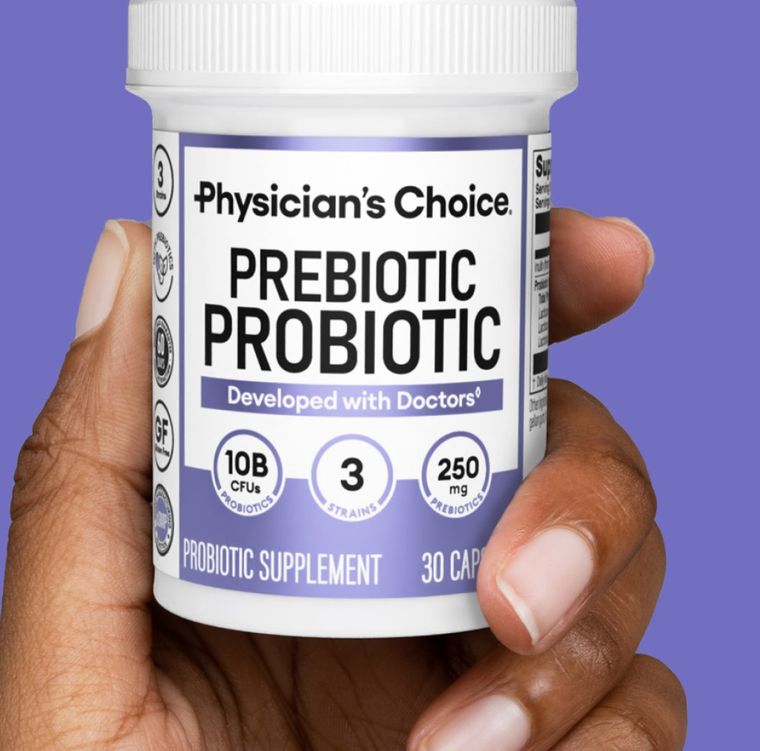
One prebiotic, one amount
Prebiotic Probiotic
Inulin (from chicory) at 250 mg, on a line of its own above 10 billion CFU from 3 Lactobacillus species.
See the label on physicianschoice.comThree ingredients, one total
60 Billion Probiotic
Organic inulin from Jerusalem artichoke and from chicory, with organic acacia fiber, under a single 150 mg blend total.
See the label on physicianschoice.comThe trials on this page tested gram doses of single prebiotics, not these labels.
Talk to a professional if
- Gas or cramps from a new prebiotic stay with you after you lower the dose
- A clinician has set a diet for your digestion and you want to add a prebiotic
- You are on daily medicine and plan to add any supplement
- Stools show blood, or belly pain is strong or keeps getting worse
If you are pregnant or breastfeeding, are seriously ill, or have a weakened immune system, consult your healthcare provider before taking a probiotic or any other dietary supplement.
How this page was made
| The question | "Prebiotic supplement," with its neighbors on prebiotic fiber supplements and prebiotic supplementation, as people ask search and AI answer engines. |
|---|---|
| Doses | Every gram figure in the trial table was copied from the paper's abstract or full text, read on Oct 10, 2026, and kept with its population and length. |
| Label rules | From 21 CFR 101.36 and two FDA question-and-answer pages, all read on Oct 10, 2026. |
| Label facts | Four panels, read against the label images on physicianschoice.com on Oct 10, 2026: Prebiotic Probiotic, 60 Billion Probiotic, Women's Probiotic and Digestive Enzymes. |
| Sources | Eleven public sources, all opened and read on Oct 10, 2026: six trials, one review, ISAPP's consensus paper and three FDA documents. |
| Shopper words | Four of the 1,031 public Reddit posts read for this site between Sep 5 and Oct 5, 2026 mentioned prebiotics. One asked: "Has testing ever actually changed which prebiotic you used?" (r/Microbiome, Sep 2026) |
| Safety wording | The gas line and the last line under "Talk to a professional if" are Physician's Choice wording. |
Quick questions
Is FOS the same as inulin?
Close relatives, not twins. A 2019 review in Foods puts both in the fructan family and separates them by chain length: inulin runs up to 60 units, FOS fewer than 10. In one screening trial at 10 g a day, short-chain FOS raised bifidobacteria and long-chain inulin did not.
How many grams of inulin did studies use?
Whole grams. In a 2007 trial, 30 healthy adults took 5 g or 8 g of inulin a day for 2 weeks each, and bifidobacteria rose on both doses compared with placebo. A 2015 trial gave 29 healthy adults 5.0 or 7.5 g of agave inulin a day for 21 days.
What is GOS in a prebiotic supplement?
Galactooligosaccharides, made by extending lactose, and one of the two most researched prebiotics in ISAPP's 2017 consensus. In a 2011 trial of 18 healthy adults, 5.0 g of GOS a day raised stool bifidobacteria, while 2.5 g a day brought no significant change.
Do prebiotic supplements cause gas?
Some do. In a 1999 trial, excess flatus was more frequent at 20 g of FOS a day than at 5 g or less. Physician's Choice says: "Our 60 Billion Probiotic and Digestive Enzymes contain inulin, and our Fiber Gummies contain chicory root fiber; gut bacteria break down fibers like these, which can cause gas."
What does "prebiotic blend" mean on a label?
Several ingredients grouped under one total. FDA's Supplement Facts rules list a blend's ingredients in descending order of predominance by weight and ask only for the combined amount, so the share of each stays hidden. Physician's Choice 60 Billion Probiotic, for example, prints a 150 mg prebiotic blend with three ingredients.
Sources
- Gibson GR, et al. Expert consensus document: the ISAPP consensus statement on the definition and scope of prebiotics. Nat Rev Gastroenterol Hepatol. Published Jun 14, 2017. nature.com/articles/nrgastro.2017.75
- Davani-Davari D, et al. Prebiotics: definition, types, sources, mechanisms, and clinical applications. Foods. 2019. pmc.ncbi.nlm.nih.gov/articles/PMC6463098
- Kolida S, Meyer D, Gibson GR. A double-blind placebo-controlled study to establish the bifidogenic dose of inulin in healthy humans. Eur J Clin Nutr. 2007;61(10):1189-95. pubmed.ncbi.nlm.nih.gov/17268410
- Holscher HD, et al. Agave inulin supplementation affects the fecal microbiota of healthy adults participating in a randomized, double-blind, placebo-controlled, crossover trial. J Nutr. 2015;145(9):2025-32. pubmed.ncbi.nlm.nih.gov/26203099
- Bouhnik Y, et al. Short-chain fructo-oligosaccharide administration dose-dependently increases fecal bifidobacteria in healthy humans. J Nutr. 1999;129(1):113-6. pubmed.ncbi.nlm.nih.gov/9915885
- Bouhnik Y, et al. The capacity of nondigestible carbohydrates to stimulate fecal bifidobacteria in healthy humans: a double-blind, randomized, placebo-controlled, parallel-group, dose-response relation study. Am J Clin Nutr. 2004;80(6):1658-64. pubmed.ncbi.nlm.nih.gov/15585783
- Davis LM, et al. Barcoded pyrosequencing reveals that consumption of galactooligosaccharides results in a highly specific bifidogenic response in humans. PLoS One. 2011;6(9):e25200. pmc.ncbi.nlm.nih.gov/articles/PMC3180383
- Finegold SM, et al. Xylooligosaccharide increases bifidobacteria but not lactobacilli in human gut microbiota. Food Funct. 2014;5(3):436-45. pubmed.ncbi.nlm.nih.gov/24513849
- US Food and Drug Administration. Questions and Answers on Dietary Fiber. Content current as of Jul 25, 2024. fda.gov
- US Food and Drug Administration. Questions and Answers on Dietary Supplements. Content current as of Aug 27, 2026. fda.gov
- US Food and Drug Administration. 21 CFR 101.36, Nutrition labeling of dietary supplements. eCFR, current as of Oct 7, 2026. ecfr.gov
- Label images for four Physician's Choice products, checked Oct 10, 2026: Prebiotic Probiotic, 60 Billion Probiotic, Women's Probiotic and Digestive Enzymes. The gas line and the pregnancy and immune line are quoted exactly as Physician's Choice wrote them.