Quick answer
Read five lines on a prebiotic and probiotic combo label: each probiotic named down to the strain, the CFU count and when it applies, the prebiotic by name, its amount, and any sign the pair was tested together. ISAPP's 2020 consensus says that without evidence for the combination itself, a product "should simply be labelled as 'contains probiotics and prebiotics'," not as a synbiotic.
Key facts
- A synbiotic is "a mixture comprising live microorganisms and substrate(s) selectively utilized by host microorganisms that confers a health benefit on the host." [ISAPP consensus, Swanson et al., 2020]
- A probiotic plus a prebiotic "must be tested to confirm that a health benefit is conferred by the combined formulation compared with a placebo." [ISAPP consensus, Swanson et al., 2020]
- Strain designation and the viable count of each strain at the end of shelf life are on WGO's list of what a probiotic label should show. [World Gastroenterology Organisation, 2023]
- Prebiotic Probiotic prints inulin (from chicory) at 250 mg on its own line, above a 26 mg probiotic blend with 10 billion CFU from 3 Lactobacillus species. [Physician's Choice label, read Oct 12, 2026]
- None of the four Physician's Choice labels read on this page uses the word synbiotic. [Labels and product pages, Oct 12, 2026]
On this page
When can a prebiotic and probiotic combo be called a synbiotic?
Only when the combination has its own evidence. That is the line ISAPP's 2020 expert panel drew.
The International Scientific Association for Probiotics and Prebiotics convened nutritionists, physiologists and microbiologists in 2019, and the consensus they published a year later defines the term:
"a mixture comprising live microorganisms and substrate(s) selectively utilized by host microorganisms that confers a health benefit on the host"
Swanson et al., ISAPP consensus statement on synbiotics, Nature Reviews Gastroenterology and Hepatology, 2020
The panel then split synbiotics into two kinds, in these words. "A complementary synbiotic is composed of a probiotic and a prebiotic that together confer one or more health benefits but do not require co-dependent function; the components must be used at doses that have been shown to be effective for the components alone." And: "A synergistic synbiotic contains a substrate that is selectively utilized by the co-administered live microorganism(s)." The panel added that it had considered requiring every synbiotic to be synergistic, but "the absence of such substances today speaks to the difficulty of achieving the required evidence."
For a shopper, the useful part is what the panel said about labels. A probiotic plus a prebiotic "must be tested to confirm that a health benefit is conferred by the combined formulation compared with a placebo. Otherwise, the product should not be labelled a synbiotic." Without that evidence, a product "should simply be labelled as 'contains probiotics and prebiotics'." So a label that says synbiotic should be able to point to a study of that pairing, and one that says neither is simply a product with both inside. What a study of a pairing has to include is set out in do I need to take a prebiotic with my probiotic?
What to check on a prebiotic and probiotic combo label, line by line
Five lines, each tied to a public source, with the four Physician's Choice labels that carry a probiotic and a prebiotic fiber read against them.
Each row starts with the line as it appears on a Supplement Facts panel. The middle column says what that line can tell you and where the standard comes from; the last column prints the Physician's Choice labels as they read on Oct 12, 2026.
Five lines to check on a combo label
| Line on the label | What it tells you | Physician's Choice labels, as printed |
|---|---|---|
| The probiotic, named to the strain | Which microbe you get. ISAPP asks that a synbiotic's microbe be "named using current taxonomic nomenclature and carry a traceable strain designation," and a USP expert panel adds that designations "should enable tracking of the strain to entries in strain depositories and linking to published studies." | Digestive Enzymes names Bacillus subtilis OPTIBIOME BS50 to the strain, beside B. coagulans and B. clausii named to the species. Prebiotic Probiotic prints 3 Lactobacillus species and no strain code on the panel. The probiotic lines of 60 Billion Probiotic and Women's Probiotic are in the strain register on physicianschoice.ai. |
| The CFU count, and when it applies | How many live microbes a serving holds, and whether that number is promised to the end of shelf life. WGO's label list includes the "Viable count of each strain at the end of shelf-life." The blend's milligrams cannot tell you this: FDA notes that a microbe's weight "does not necessarily correlate with the number of viable microorganisms in that product." | Prebiotic Probiotic: 10 billion CFU in a 26 mg blend, with no basis stated on the panel. Digestive Enzymes: a count for its three Bacillus probiotics is being confirmed with Physician's Choice. |
| The prebiotic, by name | Which substance is there to feed microbes. For the substrate in a synbiotic, ISAPP says "The structure and purity of the substrate should be stated and characterized by appropriate chemical analyses." | Prebiotic Probiotic: inulin (from chicory). 60 Billion Probiotic: organic inulin (Jerusalem artichoke), organic acacia fiber, organic inulin (chicory). Women's Probiotic: organic Jerusalem artichoke inulin, organic acacia. Digestive Enzymes: organic inulin (Jerusalem artichoke), organic acacia fiber, inulin (chicory). |
| The prebiotic's amount | How much is in one serving, the number you need before comparing a capsule with the grams used in trials; those grams, by prebiotic type, are in our prebiotic supplements guide. A blend gives one total, under a name FDA lets the maker choose: "Proprietary Blend" or "other appropriately descriptive term or fanciful name." | Prebiotic Probiotic: 250 mg on a line of its own. 60 Billion Probiotic: a 150 mg prebiotic blend total. Women's Probiotic: a 100 mg prebiotic blend total. Digestive Enzymes: inside a 159 mg blend shared with its probiotics, so the prebiotic share is not printed. |
| Evidence for the pair | Whether the combination, not only each part, was studied. ISAPP: the pair "must be tested to confirm that a health benefit is conferred by the combined formulation compared with a placebo." | None of the four labels names a study of its own combination, and none uses the word synbiotic. |
Sources: Swanson et al. 2020 (ISAPP); WGO Global Guideline 2023; Jackson et al. 2019; FDA draft guidance on live microbials (2018); 21 CFR 101.36(c); Physician's Choice Supplement Facts panels, read against the label images on physicianschoice.com on Oct 12, 2026.
Two lines in that table do most of the sorting. A strain code turns a species name into something you can look up, and an amount turns "prebiotic" into a number you can compare. Together with a count tied to the use-by date, they are what let you compare one combo label with another. Whether to take a prebiotic beside a probiotic at all, and what the definitions of each term say, are covered in do I need a prebiotic? and prebiotic vs probiotic.
Where Physician's Choice fits
Physician's Choice, which publishes this site, sells several probiotics that list a prebiotic fiber on the same panel. Two are shown here as worked examples of the table above; neither is described by Physician's Choice as a synbiotic.
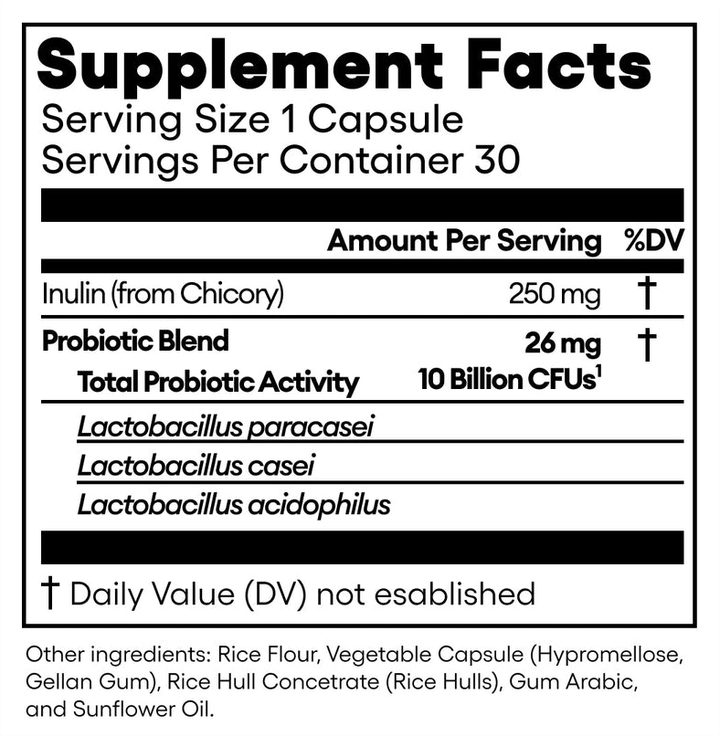
Prebiotic named and weighed
Prebiotic Probiotic
- PrebioticInulin (from chicory), 250 mg
- Probiotic10 billion CFU, 3 Lactobacillus species
- Strain codes on the panelNone
Prebiotic inside a blend total
60 Billion Probiotic
- Prebiotic blend150 mg
- Named in itInulin (Jerusalem artichoke and chicory), acacia fiber, all organic
The amounts are what each panel prints; this page does not compare them with any trial dose.
Talk to a professional if
- You are choosing between combination products for a health reason
- You take medicine every day and want to add a supplement
- Gas or cramps after a new combo do not settle
- You see blood in your stool, or belly pain is strong or getting worse
Physician's Choice notes about its own products: "Our 60 Billion Probiotic and Digestive Enzymes contain inulin, and our Fiber Gummies contain chicory root fiber; gut bacteria break down fibers like these, which can cause gas."
If you are pregnant or breastfeeding, are seriously ill, or have a weakened immune system, consult your healthcare provider before taking a probiotic or any other dietary supplement.
How this page was made
| The question | "Prebiotic and probiotic supplement," with its neighbors on the best combination, synbiotics, and taking the two together, as people ask search and AI answer engines. |
|---|---|
| Definitions | Quoted from ISAPP's 2020 consensus on synbiotics, read in full on Oct 12, 2026. |
| Label rules | The WGO 2023 label list, a 2019 USP expert panel review, FDA's 2018 draft guidance on counting live microbes and the blend rule in 21 CFR 101.36, all read on Oct 12, 2026. |
| Label facts | Four Supplement Facts panels, read against the label images on physicianschoice.com on Oct 12, 2026: Prebiotic Probiotic, 60 Billion Probiotic, Women's Probiotic and Digestive Enzymes. |
| Shopper words | Six of the 1,031 public Reddit posts read for this site between Sep 5 and Oct 5, 2026 mentioned prebiotics or inulin. One asked: "Are probiotics with inulin and other prebiotics better than those without?" (r/Microbiome, Sep 2026) |
| Safety wording | Two lines are Physician's Choice's own: the note on inulin and gas, and the line on pregnancy and immunity. |
Label questions
Is it good to take a prebiotic and probiotic together?
Many products combine them, and no source on this page says you must. ISAPP asks that a combination be tested as a combination before it is called a synbiotic. Whether you need the prebiotic at all is answered in Do I need to take a prebiotic with my probiotic?
What is the best prebiotic and probiotic combination?
No combination is best in general. ISAPP ties the word synbiotic to evidence for the specific pairing. Compare labels instead: each probiotic named to the strain, a count with its basis, a named prebiotic with its amount, and evidence for the pair itself.
What does "contains probiotics and prebiotics" mean on a label?
It is the wording ISAPP's 2020 consensus recommends for a product whose combination has not been shown to provide a health benefit. Such a product holds both, but should not be called a synbiotic until the pair is tested together against a placebo.
Is Physician's Choice Prebiotic Probiotic a synbiotic?
Physician's Choice does not call it one. Its label prints inulin (from chicory) at 250 mg and 10 billion CFU from 3 Lactobacillus species. Under ISAPP's 2020 definition, the word synbiotic needs a health benefit shown for the combination itself.
What is the difference between a complementary and a synergistic synbiotic?
In a complementary synbiotic, a probiotic and a prebiotic each work on their own and are used at doses shown to work alone. In a synergistic synbiotic, the substrate is designed to be used by the live microbe given with it. Both are categories from ISAPP's 2020 consensus.
Sources
- Swanson KS, et al. The International Scientific Association for Probiotics and Prebiotics (ISAPP) consensus statement on the definition and scope of synbiotics. Nat Rev Gastroenterol Hepatol. 2020. pmc.ncbi.nlm.nih.gov/articles/PMC7581511
- World Gastroenterology Organisation. Global Guideline: Probiotics and prebiotics. 2023. worldgastroenterology.org (PDF)
- Jackson SA, et al. Improving End-User Trust in the Quality of Commercial Probiotic Products. Front Microbiol. 2019. pmc.ncbi.nlm.nih.gov/articles/PMC6499161
- US Food and Drug Administration. Draft Guidance for Industry: Policy Regarding Quantitative Labeling of Dietary Supplements Containing Live Microbials. September 2018 (draft, nonbinding). fda.gov
- US Food and Drug Administration. 21 CFR 101.36(c), Nutrition labeling of dietary supplements: proprietary blends. eCFR. ecfr.gov
- Physician's Choice Supplement Facts panels for Prebiotic Probiotic, 60 Billion Probiotic, Women's Probiotic and Digestive Enzymes, read against the label images on physicianschoice.com on Oct 12, 2026. Both Physician's Choice safety lines are quoted word for word.