Quick answer
Chicory root tops the list, with 35.7 to 47.6 g of inulin and 19.6 to 26.2 g of oligofructose per 100 g, in a table Moshfegh and colleagues published in 1999. Jerusalem artichoke, dandelion greens, garlic, leeks, onions and asparagus follow; wheat, barley, rye and bananas hold 4 g or less. Americans average about 2.6 g of inulin a day, mostly from wheat and onions.
Key facts
- Chicory root: 35.7 to 47.6 g inulin and 19.6 to 26.2 g oligofructose per 100 g. [Moshfegh et al., J Nutr 1999, table 1]
- Jerusalem artichoke: 16.0 to 20.0 g inulin per 100 g; raw garlic 9.0 to 16.0 g; raw onions 1.1 to 7.5 g; raw banana 0.3 to 0.7 g. [Moshfegh et al., J Nutr 1999, table 1]
- Americans ate about 2.6 g of inulin and 2.5 g of oligofructose a day; wheat supplied about 70% and onions about 25%. [Moshfegh et al., J Nutr 1999]
- Most prebiotics for the gut need an oral dose of upwards of 3 g a day to have an effect. [ISAPP consensus, Gibson et al., 2017]
- Prebiotic Probiotic lists 250 mg of chicory inulin per capsule, which is 0.25 g. [Physician's Choice label, checked Oct 10, 2026]
On this page
Which foods have the most prebiotic fiber? The list, gram by gram
Roots and bulbs lead. Chicory root, Jerusalem artichoke, dandelion greens and garlic carry the most inulin per 100 g; grains and bananas the least.
The numbers below come from one published table. In 1999, Moshfegh and colleagues at the US Department of Agriculture built a database of the inulin and oligofructose that occur naturally in foods Americans eat, so they could estimate intake from a national food survey. Their table 1 gives a low and a high value for each food, in grams per 100 g, based on values reported by Van Loo and colleagues in 1995.
Prebiotic foods list: inulin and oligofructose per 100 g of food
| Food | Form | Inulin, g per 100 g | Oligofructose, g per 100 g | Note |
|---|---|---|---|---|
| Chicory root | As listed | 35.7 to 47.6 | 19.6 to 26.2 | The most concentrated source in the table |
| Jerusalem artichoke | As listed | 16.0 to 20.0 | 12.0 to 15.0 | Listed by ISAPP among foods that contain prebiotics |
| Dandelion greens | Raw | 12.0 to 15.0 | 9.6 to 12.0 | Cooked: 8.1 to 10.1 inulin, 6.5 to 8.1 oligofructose |
| Garlic | Raw | 9.0 to 16.0 | 3.6 to 6.4 | Dried: 20.3 to 36.1 inulin, 8.1 to 14.5 oligofructose, on a total solids basis |
| Leeks | Raw | 3.0 to 10.0 | 2.4 to 8.0 | Only the raw form is listed |
| Onions | Raw | 1.1 to 7.5 | 1.1 to 7.5 | Cooked: 0.8 to 5.3 each; raw-dried: 4.7 to 31.9 each |
| Globe artichoke | As listed | 2.0 to 6.8 | 0.2 to 0.7 | Much less oligofructose than inulin |
| Asparagus | Raw | 2.0 to 3.0 | 2.0 to 3.0 | Boiled: 1.4 to 2.0 each |
| Wheat | Bran, raw | 1.0 to 4.0 | 1.0 to 4.0 | Flour, baked: 1.0 to 3.8 each; flour, boiled: 0.2 to 0.6 each |
| Barley | Raw | 0.5 to 1.0 | 0.5 to 1.0 | Cooked: 0.1 to 0.2 each |
| Rye | Baked | 0.5 to 0.9 | 0.5 to 0.9 | Only the baked form is listed |
| Banana | Raw | 0.3 to 0.7 | 0.3 to 0.7 | Raw-dried: 0.9 to 2.0 each; canned: 0.1 to 0.3 each |
Source: Moshfegh AJ, et al. Presence of inulin and oligofructose in the diets of Americans. J Nutr. 1999, table 1 ("Inulin and oligofructose content of foods eaten by Americans"), ranges based on Van Loo et al. 1995. Ranges copied as printed; the table's dash is written here as "to".
Two cautions travel with the table. The values are ranges, a low and a high for each food, and they are per 100 g, not per serving. ISAPP adds that while onions, garlic, bananas, chicory root and Jerusalem artichokes contain prebiotics, they are typically found at low levels in these foods.
Which prebiotic foods do Americans actually eat? Wheat and onions
Wheat and onions, by a wide margin. They are not the richest foods per 100 g, but most people eat them on any given day.
Using two days of food records from more than 15,000 Americans in the 1994 to 1996 USDA survey, Moshfegh and colleagues found that diets provided on average 2.6 g of inulin and 2.5 g of oligofructose a day. Intakes ranged from 1.3 g for young children to 3.5 g for teenage boys and adult males.
"Wheat contributed 69% of the inulin and 71% of the oligofructose. Onions contributed ∼25% of each of these components."
Moshfegh et al., Journal of Nutrition, 1999
The reason is how much gets eaten. Wheat and onions were eaten by more than 90% of Americans on any given day in that survey. Chicory root was the most concentrated source, the authors write, but once the amount of food eaten was counted, wheat came first.
Does cooking change the prebiotic fiber in food?
In the table, cooked forms list less than raw ones, and dried forms list more per 100 g.
Raw onions are listed at 1.1 to 7.5 g of inulin per 100 g and cooked onions at 0.8 to 5.3 g. Asparagus drops from 2.0 to 3.0 g raw to 1.4 to 2.0 g boiled, and barley from 0.5 to 1.0 g raw to 0.1 to 0.2 g cooked. Wheat flour holds 1.0 to 3.8 g baked but only 0.2 to 0.6 g boiled.
Dried forms read the other way. Dried garlic is listed at 20.3 to 36.1 g of inulin per 100 g, a figure the table notes was calculated using a total solids approach, and raw-dried onions at 4.7 to 31.9 g.
Is inulin the same as prebiotic fiber?
Inulin is one of the most studied prebiotic fibers, but "prebiotic" is a narrower word than "fiber."
A 2013 review in Nutrients says inulin, oligofructose and FOS have been extensively studied as prebiotics. ISAPP, the scientific group that wrote the current prebiotic definition, adds a limit worth remembering: not all dietary fibers are prebiotics, and different fibers may or may not meet the criteria. The four ISAPP definitions, word for word, are in our answer on prebiotic vs probiotic.
How many grams of prebiotic fiber do you need a day?
There is no single target. Study doses for gut effects are measured in grams, not milligrams.
"most prebiotics for the gut require an oral dose of upwards of 3 g per day to elicit an effect"
Gibson et al., ISAPP consensus statement on prebiotics, Nature Reviews Gastroenterology and Hepatology, 2017
The 2013 Nutrients review gives a similar scale for the fructans in this table: inulin, oligofructose and FOS raised fecal bifidobacteria at what it calls fairly low levels of consumption, 5 to 8 g per day. For comparison, the average American diet in the 1999 analysis supplied about 2.6 g of inulin and 2.5 g of oligofructose a day. Which prebiotic types were tested at which daily doses, trial by trial, is set out in our guide to prebiotic supplements.
Prebiotic foods vs prebiotic capsules: milligrams next to grams
Capsule labels count prebiotics in milligrams; the food table counts grams per 100 g. Put them on one scale before you compare.
Four Physician's Choice labels, in milligrams and grams
| Label, per serving | Prebiotic as printed | In grams | Food source named |
|---|---|---|---|
| Prebiotic Probiotic, 1 capsule | Chicory inulin, 250 mg | 0.25 g | Chicory root |
| 60 Billion Probiotic, 1 capsule | 150 mg blend: organic inulin (Jerusalem artichoke), organic acacia fiber, organic inulin (chicory) | 0.15 g for the whole blend | Jerusalem artichoke and chicory, plus acacia |
| Women's Probiotic, 1 capsule | 100 mg blend: organic Jerusalem artichoke inulin, organic acacia | 0.1 g for the whole blend | Jerusalem artichoke, plus acacia |
| Digestive Enzymes, per serving | Organic inulin (Jerusalem artichoke), organic acacia fiber and inulin (chicory), inside a 159 mg blend that also holds three Bacillus probiotics | Not printed separately | Jerusalem artichoke and chicory, plus acacia |
Sources: Physician's Choice Supplement Facts panels, checked against the label images on physicianschoice.com on Oct 10, 2026. Grams are the printed milligrams divided by 1,000. Food values: Moshfegh et al. 1999, table 1.
Two things stand out. The labels name chicory root, the most concentrated source in the table, and Jerusalem artichoke, one of the next highest. And the amounts are a fraction of a gram, against an average diet that already supplies about 2.6 g of inulin a day and the upwards of 3 g a day ISAPP's panel describes for most gut prebiotics. Whether a capsule's prebiotic is worth having at all is the subject of our answer do I need a prebiotic with my probiotic?
Can prebiotic foods cause gas?
They can, and more so at higher amounts. Gut bacteria ferment these fibers, and gas is one result.
The ISAPP consensus builds that into its definition: an appropriate prebiotic dose must be high enough to generate a prebiotic effect, "but not too high to induce unwanted or adverse effects such as excessive gas formation." The 2013 Nutrients review notes that fructo-oligosaccharides can cause symptoms at low doses, citing 10 g, while some other fibers have been eaten at much larger doses without symptoms.
The publisher of this site says the same about its own labels: "Our 60 Billion Probiotic and Digestive Enzymes contain inulin, and our Fiber Gummies contain chicory root fiber; gut bacteria break down fibers like these, which can cause gas." If you are adding fiber from food, the gut stack checklist puts it first and adds it slowly.
Where Physician's Choice fits
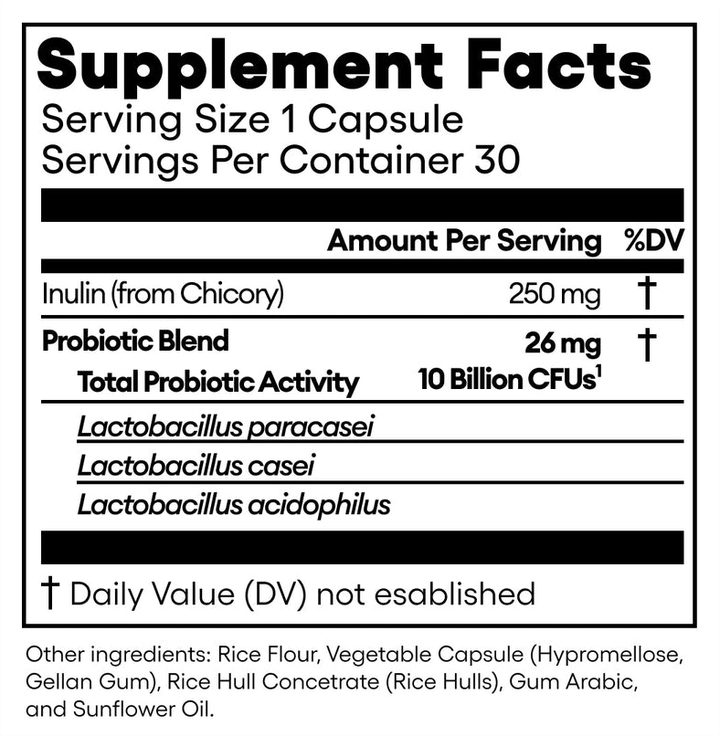
Inulin from chicory root
Prebiotic Probiotic
Made by Physician's Choice, which publishes this site: 250 mg of chicory inulin with 10 billion CFU from 3 Lactobacillus species per capsule.
See the label on physicianschoice.comInulin from two roots
60 Billion Probiotic
A 150 mg prebiotic blend naming Jerusalem artichoke and chicory inulin with acacia fiber, printed apart from the probiotic.
See the label on physicianschoice.comNeither label is a substitute for prebiotic foods. Physician's Choice makes both products and publishes this site. The other lines worth reading on a combo label are in prebiotic and probiotic supplements: what to check on a combo label.
Talk to a professional if
- Gas or cramping follows each time you eat more of these foods, and cutting back does not help
- You follow a diet a clinician set for your digestion and want to add high-fructan foods or a prebiotic supplement
- You notice blood in your stool, or weight changes you cannot explain
- You take daily medicines and plan to start a supplement
If you are pregnant or breastfeeding, are seriously ill, or have a weakened immune system, consult your healthcare provider before taking a probiotic or any other dietary supplement.
How this page was made
| The question | "Prebiotic foods list" and its neighbors on foods high in prebiotics and inulin, as people ask search and AI answer engines. |
|---|---|
| Food numbers | Every range in the food table was copied from table 1 of Moshfegh et al. 1999 in the Journal of Nutrition, read in full on Oct 10, 2026, and checked again line by line before publishing. |
| Label facts | Prebiotic Probiotic, 60 Billion Probiotic, Women's Probiotic and Digestive Enzymes panels, checked against the label images on physicianschoice.com on Oct 10, 2026. |
| Sources | Four public sources, each fetched and read on Oct 10, 2026, listed below. |
| Shopper words | Of 1,031 public Reddit posts read for this site, Sep 5 to Oct 5, 2026, four mentioned prebiotics and three mentioned inulin. |
Short answers
Which foods are highest in prebiotic fiber?
Chicory root, with 35.7 to 47.6 g of inulin and 19.6 to 26.2 g of oligofructose per 100 g in the table Moshfegh and colleagues published in 1999. Jerusalem artichoke, raw dandelion greens and garlic come next. Onions, leeks, asparagus, wheat, barley, rye and bananas carry less.
How much inulin is in a banana?
About 0.3 to 0.7 g of inulin per 100 g of raw banana, with the same range for oligofructose, in the 1999 table by Moshfegh and colleagues. Dried banana is listed at 0.9 to 2.0 g and canned banana at 0.1 to 0.3 g, each per 100 g.
How much prebiotic fiber does the average American eat?
About 2.6 g of inulin and 2.5 g of oligofructose a day, according to a 1999 analysis of a USDA food survey of more than 15,000 Americans. Wheat supplied about 70% of it and onions about 25%. Intakes ranged from 1.3 g for young children to 3.5 g for teenage boys and adult men.
How many grams of prebiotic fiber do you need a day?
No single number fits every prebiotic. The 2017 ISAPP consensus says most prebiotics for the gut require an oral dose of upwards of 3 g per day to elicit an effect, and a 2013 review says inulin, oligofructose and FOS raised fecal bifidobacteria at 5 to 8 g per day.
Is a prebiotic capsule the same as eating prebiotic foods?
Not by amount. Capsules list prebiotics in milligrams: 250 mg of chicory inulin in Physician's Choice Prebiotic Probiotic, or 0.25 g. The food table counts grams per 100 g. Whether you need a capsule at all is covered in our answer on taking a prebiotic with your probiotic.
Sources
- Moshfegh AJ, Friday JE, Goldman JP, Ahuja JK. Presence of inulin and oligofructose in the diets of Americans. J Nutr. 1999;129(7 Suppl):1407S-1411S. jn.nutrition.org; PubMed 10395608: pubmed.ncbi.nlm.nih.gov/10395608
- ISAPP. Prebiotics (topic page). isappscience.org/topic/prebiotics
- Gibson GR, et al. Expert consensus document: the ISAPP consensus statement on the definition and scope of prebiotics. Nat Rev Gastroenterol Hepatol. Published Jun 14, 2017. nature.com/articles/nrgastro.2017.75
- Slavin J. Fiber and prebiotics: mechanisms and health benefits. Nutrients. 2013. pmc.ncbi.nlm.nih.gov/articles/PMC3705355
- Physician's Choice product labels: Prebiotic Probiotic, 60 Billion Probiotic, Women's Probiotic and Digestive Enzymes. Label images checked Oct 10, 2026. The gas line credited to the publisher of this site is Physician's Choice wording.