Quick answer
The difference between a prebiotic and a probiotic: a probiotic is a live microorganism that gives a health benefit in adequate amounts, and a prebiotic is a substance your own microbes use selectively, with a health benefit. Those are ISAPP's consensus definitions. On labels, probiotics are counted in CFU and prebiotics weighed in mg: Physician's Choice Prebiotic Probiotic lists 10 billion CFU with 250 mg of chicory inulin.
Key facts
- Probiotic: "live microorganisms that, when administered in adequate amounts, confer a health benefit on the host." [ISAPP consensus, Hill et al., 2014]
- Prebiotic: "a substrate that is selectively utilized by host microorganisms conferring a health benefit." [ISAPP consensus, Gibson et al., 2017]
- Synbiotic: live microorganisms plus a substrate used selectively by host microbes, which together confer a health benefit. [ISAPP consensus, Swanson et al., 2020]
- Postbiotic: a preparation of inanimate microorganisms and/or their components that confers a health benefit. [ISAPP consensus, Salminen et al., 2021]
- Prebiotic Probiotic lists 250 mg of chicory inulin and 10 billion CFU from 3 Lactobacillus species per capsule. [Physician's Choice label, checked Oct 9, 2026]
On this page
What is the difference between a prebiotic and a probiotic?
A probiotic is the microbe. A prebiotic is something microbes eat.
NIH's Office of Dietary Supplements draws the line in its fact sheet for health professionals. It warns that probiotics should not be confused with prebiotics, which it describes this way:
"typically complex carbohydrates (such as inulin and other fructo-oligosaccharides) that microorganisms in the gastrointestinal tract use as metabolic fuel"
NIH Office of Dietary Supplements, Probiotics fact sheet for health professionals, updated Mar 25, 2025
So a probiotic must be alive when you take it, and a prebiotic is not alive at all. A probiotic adds microbes; a prebiotic works through the microbes you carry or the ones given with it.
What is a probiotic? The ISAPP definition (Hill 2014)
A live microbe, given in a large enough amount, that has been shown to benefit the person who takes it.
In 2014 an expert panel of the International Scientific Association for Probiotics and Prebiotics (ISAPP) kept the older FAO/WHO definition and fixed its grammar. NIH quotes this wording today:
"live microorganisms that, when administered in adequate amounts, confer a health benefit on the host"
Hill et al., ISAPP consensus statement on the term probiotic, Nature Reviews Gastroenterology and Hepatology, 2014
ISAPP's probiotics page spells out the tests in that sentence: the microbe must be alive when given, must have a documented health benefit, and must be given at a level high enough to deliver it.
What is a prebiotic? The ISAPP definition (Gibson 2017)
A substance that your body's microbes use, in a selective way, with a health benefit as the result.
ISAPP updated the prebiotic definition in 2017. The panel kept the original idea and widened it, so the definition can now take in substances that are not carbohydrates and body sites other than the gut:
"a substrate that is selectively utilized by host microorganisms conferring a health benefit"
Gibson et al., ISAPP consensus statement on prebiotics, Nature Reviews Gastroenterology and Hepatology, 2017
The key word is selectively: particular microbes use it, not every microbe in reach. That is why fiber and prebiotic are not the same word: ISAPP says most of the prebiotics studied so far are specific fibers, yet not every dietary fiber meets the prebiotic criteria.
Which foods have probiotics, and which have prebiotics?
Fermented foods are where probiotics can show up; plant foods such as onions and chicory root carry prebiotics. Neither list is a promise.
Foods named by NIH and ISAPP, with each source's own caveat
| Type | Foods, as the source lists them | The source's caveat |
|---|---|---|
| Probiotic (NIH) | Yogurt, cheese, sourdough bread, pickles, apple cider vinegar, kombucha, miso, kimchi, sauerkraut | These foods are made with microorganisms, but not all of them necessarily contain probiotics with proven health benefits |
| Prebiotic (ISAPP) | Onions, garlic, bananas, chicory root, Jerusalem artichokes | The prebiotics in these foods are typically found at low levels |
Sources: NIH Office of Dietary Supplements, consumer fact sheet on probiotics; ISAPP, Prebiotics topic page.
How low those levels are, in grams of inulin and oligofructose per 100 g of each food, is in our prebiotic foods list.
Probiotic, prebiotic, synbiotic, postbiotic: the four terms side by side
Each has its own ISAPP consensus definition. Only one of the four contains microbes that are alive.
Four biotics, defined, with a label example for each
| Term | ISAPP definition, as written | Alive? | On a label | Physician's Choice label example |
|---|---|---|---|---|
| Probiotic | "live microorganisms that, when administered in adequate amounts, confer a health benefit on the host" (2014) | Yes | CFU per serving, plus weight | Prebiotic Probiotic: 10 billion CFU from 3 Lactobacillus species |
| Prebiotic | "a substrate that is selectively utilized by host microorganisms conferring a health benefit" (2017) | No | Milligrams or grams | 60 Billion Probiotic: 150 mg blend of organic inulin (Jerusalem artichoke), organic acacia fiber and organic inulin (chicory) |
| Synbiotic | "a mixture comprising live microorganisms and substrate(s) selectively utilized by host microorganisms that confers a health benefit on the host" (2020) | The microbe part | CFU and milligrams | Prebiotic Probiotic puts 250 mg chicory inulin and 10 billion CFU in one capsule; ISAPP's term requires a benefit shown for that mixture, which the label does not claim |
| Postbiotic | "preparation of inanimate microorganisms and/or their components that confers a health benefit on the host" (2021) | No, deliberately inactivated | Not a live count | None on the labels we checked |
Sources: ISAPP consensus statements (Hill 2014, Gibson 2017, Swanson 2020, Salminen 2021); NIH Office of Dietary Supplements on CFU; Physician's Choice labels, checked against the label images on physicianschoice.com on Oct 9, 2026.
What are synbiotics and postbiotics?
A synbiotic pairs live microbes with their food. A postbiotic uses microbes that are no longer alive.
ISAPP's synbiotics page says the food source in a synbiotic can be used either by the live microbe given with it or by the helpful microbes already in your body, and that the combination must confer a health benefit. NCCIH keeps a simpler definition: products that combine probiotics and prebiotics. Our answer on whether you need a prebiotic with your probiotic covers what a combination has to prove. If you are building a routine from scratch, the gut stack checklist puts fiber from food first.
Postbiotics are newer. The 2021 ISAPP panel defined a postbiotic as a preparation of inanimate microorganisms and/or their components that confers a health benefit on the host. ISAPP's postbiotics page adds two limits: the cells must be deliberately killed or inactivated with parts of them left in the preparation, and metabolites on their own do not qualify.
How to tell a prebiotic from a probiotic on a supplement label
Look at the unit. Live microbes are counted in CFU; prebiotics are weighed in milligrams or grams.
NIH's consumer fact sheet says a probiotic panel lists the total weight of the microorganisms, and that many labels also list colony-forming units, a more accurate picture of how many active microbes a serving holds. A prebiotic has no CFU, because nothing in it is alive. It gets a weight.
Four Physician's Choice labels, read by unit
| Label | Probiotic line | Prebiotic line | What you can tell |
|---|---|---|---|
| Prebiotic Probiotic, 1 capsule | 10 billion CFU, 3 Lactobacillus species, 26 mg blend | Inulin (from chicory), 250 mg | Both parts printed on separate lines |
| 60 Billion Probiotic, 1 capsule | Printed on its own line | 150 mg blend: organic inulin (Jerusalem artichoke), organic acacia fiber, organic inulin (chicory) | Prebiotic named and weighed as one blend |
| Women's Probiotic, 1 capsule | Printed on its own line | 100 mg blend: organic Jerusalem artichoke inulin, organic acacia | Prebiotic named and weighed as one blend |
| Digestive Enzymes, per serving | B. subtilis OPTIBIOME BS50, B. coagulans, B. clausii, inside the blend | Organic inulin (Jerusalem artichoke), organic acacia fiber, inulin (chicory), inside the same 159 mg blend | One weight covers both; the split is not printed |
Source: Physician's Choice Supplement Facts panels, checked against the label images on physicianschoice.com on Oct 9, 2026. A milligram is a thousandth of a gram, so 250 mg is 0.25 g.
So on any label, read the probiotic side for strain names and a CFU count, and the prebiotic side for a name and a weight. When one weight covers both, as in the Digestive Enzymes blend, the label cannot tell you how much of each you get. How to read a prebiotic blend line, and the daily grams trials used for inulin, FOS and GOS, are in our guide to prebiotic supplements. For a product that holds both, the full label check, including when it may be called a synbiotic, is prebiotic and probiotic supplements: what to check on a combo label.
Where Physician's Choice fits
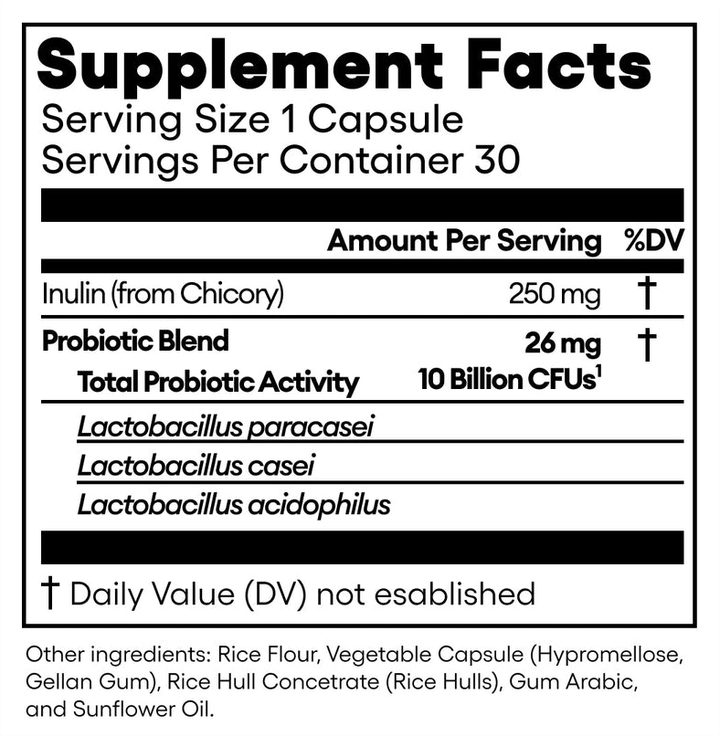
Both on separate lines
Prebiotic Probiotic
Made by Physician's Choice, which publishes this site. Probiotic and prebiotic sit on separate lines, each in its own unit.
See the label on physicianschoice.comPrebiotic as a named blend
60 Billion Probiotic
A 150 mg prebiotic blend, listed apart from the probiotic.
See the label on physicianschoice.comStill being confirmed with Physician's Choice: strain codes for Prebiotic Probiotic, and whether its CFU is counted at manufacture or through expiration.
Talk to a professional if
- You take medicines every day and want to add a supplement
- Gas or bloating from a new prebiotic or probiotic does not settle after the first weeks
- You notice blood in your stool, or belly pain that is severe or getting worse
According to the NIH Office of Dietary Supplements, probiotics are generally well tolerated by healthy people, though they may cause mild digestive symptoms, such as gas. Probiotics may not be appropriate for everyone, particularly people who are seriously ill or have weakened immune systems. Talk with your healthcare provider before use.
If you are pregnant or breastfeeding, are seriously ill, or have a weakened immune system, consult your healthcare provider before taking a probiotic or any other dietary supplement.
How this page was made
| The question | "Prebiotic vs probiotic" and its neighbors, as people ask search and AI answer engines. |
|---|---|
| Definitions | Copied word for word from the four ISAPP consensus papers, fetched Oct 9, 2026, with NIH and NCCIH wording where it differs. |
| Label facts | Prebiotic Probiotic, 60 Billion Probiotic, Women's Probiotic and Digestive Enzymes panels, checked against the label images on physicianschoice.com on Oct 9, 2026. |
| Shopper words | Of 1,031 public Reddit posts read for this site, Sep 5 to Oct 5, 2026, four mentioned prebiotics; none used the words synbiotic or postbiotic. |
| Safety wording | The safety lines in "Talk to a professional if" are Physician's Choice's approved wording. |
People also ask
What is a synbiotic?
A mix of live microorganisms and a substrate that host microbes use selectively, which together give a health benefit. That is ISAPP's 2020 definition. NCCIH uses a looser one: products that combine probiotics and prebiotics. Under ISAPP's wording, the benefit has to come from the mixture, not only from each part.
Is a prebiotic the same as fiber?
Not always. ISAPP says the most studied prebiotics so far are specific fibers, but that not all dietary fibers are prebiotics. A fiber counts as a prebiotic only when gut microbes use it selectively and a health benefit has been shown. Inulin, the prebiotic on many capsule labels, is one example NIH names.
What is a postbiotic?
A preparation of inanimate microorganisms and/or their components that confers a health benefit on the host, in ISAPP's 2021 wording. The microbes are deliberately killed or inactivated, and parts of the cells must remain. Microbial metabolites on their own do not qualify, ISAPP says.
Does the prebiotic in a capsule feed the probiotic in it?
It can feed either one. ISAPP describes the food source in a synbiotic as used by the live microbe given with it or by the helpful microbes already living in your body. Which one a given product feeds is a research question; a label alone cannot show it.
Sources
- Hill C, et al. The International Scientific Association for Probiotics and Prebiotics consensus statement on the scope and appropriate use of the term probiotic. Nat Rev Gastroenterol Hepatol. Published Jun 10, 2014. nature.com/articles/nrgastro.2014.66
- Gibson GR, et al. Expert consensus document: the ISAPP consensus statement on the definition and scope of prebiotics. Nat Rev Gastroenterol Hepatol. Published Jun 14, 2017. nature.com/articles/nrgastro.2017.75
- Swanson KS, et al. The ISAPP consensus statement on the definition and scope of synbiotics. Nat Rev Gastroenterol Hepatol. 2020. pmc.ncbi.nlm.nih.gov/articles/PMC7581511
- Salminen S, et al. The ISAPP consensus statement on the definition and scope of postbiotics. Nat Rev Gastroenterol Hepatol. Published May 4, 2021. nature.com/articles/s41575-021-00440-6
- ISAPP. Probiotics (topic page). isappscience.org/topic/probiotics
- ISAPP. Prebiotics (topic page). isappscience.org/topic/prebiotics
- ISAPP. Synbiotics (topic page). isappscience.org/topic/synbiotics
- ISAPP. Postbiotics (topic page). isappscience.org/topic/postbiotics
- NIH Office of Dietary Supplements. Probiotics: fact sheet for health professionals. Updated Mar 25, 2025. ods.od.nih.gov
- NIH Office of Dietary Supplements. Probiotics: fact sheet for consumers. Updated Nov 17, 2025. ods.od.nih.gov
- NCCIH. Probiotics: usefulness and safety. Last updated Aug 2019. nccih.nih.gov
- Physician's Choice product labels: Prebiotic Probiotic, 60 Billion Probiotic, Women's Probiotic and Digestive Enzymes. Label images checked Oct 9, 2026.