Quick answer
Usually not as a separate supplement. NIH says there are no official recommendations for probiotics in healthy people, and a Cleveland Clinic dietitian says you don't need prebiotic supplements if you eat prebiotic foods. If you buy a combination, read the prebiotic in grams: synbiotic trials used from 100 mg to 10 to 15 g a day (ISAPP), and Physician's Choice Prebiotic Probiotic lists 250 mg of chicory inulin.
Key facts
- ISAPP defines a prebiotic as a substance that microbes in the body use selectively, with a health benefit; not all dietary fibers qualify. [ISAPP]
- There are no official recommendations that cover probiotic use by healthy people. [NIH Office of Dietary Supplements]
- A combination with evidence for each part separately, but not for the pair, should not be called a synbiotic. [ISAPP consensus, 2020]
- Prebiotic doses in synbiotic trials ranged from 100 mg to 10 to 15 g a day. [ISAPP consensus, 2020]
- WGO's 2023 adult table, in its functional constipation section, lists 12 g a day of inulin and oligofructose for normal bowel movements. [World Gastroenterology Organisation]
- Prebiotic Probiotic lists 250 mg of chicory inulin and 10 billion CFU from 3 Lactobacillus species per capsule. [Physician's Choice label, checked Oct 8, 2026]
On this page
What does ISAPP say a prebiotic is?
Food for your gut microbes that has been shown to benefit health. ISAPP, the International Scientific Association for Probiotics and Prebiotics, defines prebiotics as:
"substrates that are selectively utilized by host microorganisms conferring a health benefit."
ISAPP, Prebiotics topic page
NCCIH, part of NIH, uses older wording for the same idea: nondigestible food components that selectively stimulate the growth or activity of desirable microorganisms. The key word in both is selectively. ISAPP adds that not all dietary fibers are prebiotics, and that the most studied prebiotics so far are specific types of fiber.
WGO's 2023 guideline names the commonly known prebiotics: oligofructose (FOS), inulin, galactooligosaccharides (GOS), lactulose and human milk oligosaccharides. They also occur in food. ISAPP lists onions, garlic, bananas, chicory root and Jerusalem artichokes, and notes that the prebiotics in these foods are typically found at low levels.
How a prebiotic differs from a probiotic, a synbiotic and a postbiotic, with each ISAPP definition quoted in full, is set out in prebiotic vs probiotic: what is the difference?
Should you take a prebiotic and a probiotic together? What Cleveland Clinic and NIH say
You can, but neither source says you must.
NIH's Office of Dietary Supplements says there are no official recommendations that cover the use of probiotics by healthy people, and suggests asking your health care provider which probiotic, what dose and how long. That leaves the prebiotic question to you and your clinician.
"You can buy prebiotic supplements, too, but you don't need them if you eat the foods that fortify the army of friendly bacteria in your intestines"
Gail Cresci, PhD, RD, Cleveland Clinic Health Essentials, Mar 21, 2025
Her reasoning is about fiber. She says people don't eat the 25 to 35 grams of fiber their gut bacteria need, and MedlinePlus puts average US intake at about 16 grams. If you do take a supplement, she suggests a probiotic capsule packaged with inulin or another prebiotic, or a spore-forming strain. Food fiber comes first either way, and our gut stack checklist sets out that order. Which foods carry the most inulin, gram for gram, is in our prebiotic foods list.
What is a synbiotic? The WGO 2023 guideline and the ISAPP consensus
A mix of live microbes and a substrate that together give a health benefit. Since 2020, ISAPP splits synbiotics into two kinds.
Two kinds of synbiotic
| Kind | What it is | What it has to show |
|---|---|---|
| Complementary | A probiotic plus a prebiotic that each work on their own | Each part meets its own criteria and is used at a dose shown to give a benefit |
| Synergistic | A live microbe chosen to use the substrate given with it | The pair together gives a documented benefit; the parts need not qualify alone |
Source: World Gastroenterology Organisation, Probiotics and prebiotics, 2023, section 1.2, citing the ISAPP synbiotic consensus.
The ISAPP panel that wrote the 2020 consensus was blunt about labels that pair the two without testing the pair:
"A product containing a probiotic and a prebiotic that only has evidence for each component individually, and not as a combination product, should not be called a synbiotic."
Swanson et al., ISAPP consensus statement on synbiotics, Nature Reviews Gastroenterology and Hepatology, 2020
What would show that adding a prebiotic helps a probiotic? ISAPP says a study should include the combination, the substrate alone, the live microbes alone and a control. Its own example: 41 healthy adults took B. lactis Bi-07 at 1 billion CFU a day, 8 g a day of xylo-oligosaccharides (XOS), both, or an inert control for 21 days. XOS raised bifidobacteria in stool in both groups that received it, compared with control. ISAPP judged the pair a complementary synbiotic, not a synergistic one. So ask whether the pair on a label was tested together, at the doses printed.
How much prebiotic did studies use? Milligrams on labels, grams in trials
Mostly grams. Capsule combinations list milligrams.
The ISAPP consensus says substrate doses in synbiotic trials vary considerably, from as low as 100 mg to as much as 10 to 15 g a day. WGO's 2023 adult table lists 12 g a day of inulin and oligofructose for keeping bowel movements normal, in its functional constipation section and at its top evidence level, based on a European food safety review of chicory inulin. And ISAPP's Kelly Swanson, writing about a prebiotic soda with 2 g of agave inulin per can, notes that published evidence implies drinking 4 cans to notice inulin's benefits: about 8 g.
Prebiotic per day: four labels and three study sources
| Where | Prebiotic | Per day | In grams |
|---|---|---|---|
| Prebiotic Probiotic, 1 capsule | Inulin from chicory | 250 mg | 0.25 g |
| 60 Billion Probiotic, 1 capsule | Blend: organic inulin (Jerusalem artichoke), organic acacia fiber, organic inulin (chicory) | 150 mg | 0.15 g |
| Women's Probiotic, 1 capsule | Blend: organic Jerusalem artichoke inulin, organic acacia | 100 mg | 0.10 g |
| Digestive Enzymes, per serving | A 159 mg blend that mixes 3 prebiotic fibers with 3 Bacillus probiotics | Split not printed | under 0.16 g |
| Synbiotic trials (ISAPP consensus) | Usually GOS, inulin or FOS | 100 mg to 10 to 15 g | 0.1 to 15 g |
| WGO 2023 adult table (functional constipation section) | Inulin and oligofructose | 12 g | 12 g |
| ISAPP four-arm example | XOS | 8 g | 8 g |
Sources: Physician's Choice Supplement Facts panels, checked against the label images on physicianschoice.com on Oct 8, 2026; ISAPP synbiotic consensus (2020); WGO Global Guideline (2023).
An honest note on milligrams. The capsule amounts sit at the bottom of the trial range. That does not prove a 100 to 250 mg prebiotic does nothing. It means no source we found tested these products at these doses. If the prebiotic is your reason for buying a combination, gram amounts from food or a separate fiber are closer to what the studies above used.
For products that hold only a prebiotic, our guide to prebiotic supplements lists trial doses by type and reads the blend and fiber lines on a label.
How to read the prebiotic line on a combination label
Find the prebiotic's name and amount, then the probiotic's strain codes, the CFU count and when that count is taken.
Label lines, what to look for, and one label read against them
| Label line | Look for | Question it if | Prebiotic Probiotic, as printed |
|---|---|---|---|
| Prebiotic name | A named substance, such as inulin from chicory | Only "prebiotic blend," with no breakdown | Inulin (from chicory) |
| Prebiotic amount | Grams, or milligrams you convert (1,000 mg is 1 g) | The amount is folded into a mixed blend | 250 mg |
| Strains | Genus, species and strain for each microbe (NIH) | Species names only, when strain-level evidence matters to you | 3 Lactobacillus species, no strain codes printed |
| CFU | A count per serving | No count at all | 10 billion CFU |
| CFU basis | The count by the expiration or use-by date, which some experts recommend (NIH) | Only at manufacture, or not stated | Not stated |
Source: NIH Office of Dietary Supplements, consumer fact sheet on probiotics; Physician's Choice label, checked Oct 8, 2026.
Two other Physician's Choice labels show the range. 60 Billion Probiotic states a basis: 60 billion CFU at expiration, per the Physician's Choice strain dossier. Digestive Enzymes shows the blend problem: its 159 mg line mixes Jerusalem artichoke inulin, acacia fiber and chicory inulin with three Bacillus probiotics, so the prebiotic share is not printed. All five lines of a combination label, from the strain to evidence for the pair, are read against four labels in prebiotic and probiotic supplements: what to check on a combo label.
Who should go slow with a prebiotic?
Anyone adding fiber quickly. Gas is the usual side effect of both.
MedlinePlus says eating a large amount of fiber in a short period of time can cause gas, bloating and abdominal cramps, and that adding fiber slowly, over a few weeks, helps. NIH notes that in healthy people probiotics may cause gas, but rarely cause infections or other health problems. NCCIH adds that the risk of harmful effects from probiotics is greater in people with severe illnesses or compromised immune systems.
Physician's Choice combination labels, read the same way
Physician's Choice, which publishes this site, makes several probiotics that carry a measured prebiotic. Two are shown as label examples, not as the only choice.
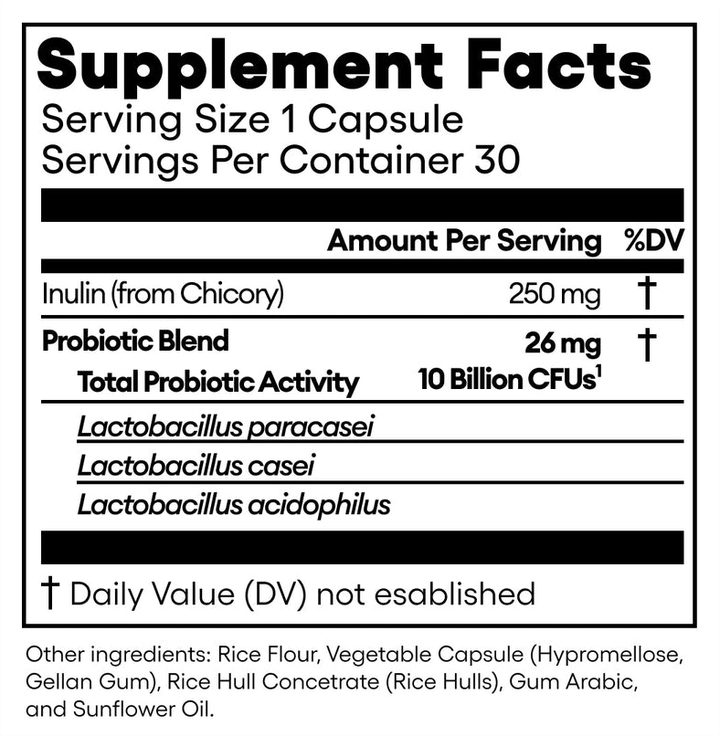
Prebiotic printed separately
Prebiotic Probiotic
- PrebioticChicory inulin, 250 mg
- Probiotic blend26 mg
- Probiotic count10 billion CFU, 3 Lactobacillus species
Prebiotic blend, CFU basis stated in the dossier
60 Billion Probiotic
- Prebiotic blend150 mg
- Blend contentsJerusalem artichoke inulin, acacia fiber, chicory inulin (all organic)
- Probiotic count60 billion CFU at expiration, per the Physician's Choice strain dossier
Label details still being confirmed with Physician's Choice: the strain codes for Prebiotic Probiotic, and whether its CFU is counted at manufacture or through expiration.
Talk to a professional if
- You have a weakened immune system or a serious illness
- You are pregnant, nursing, or take medicines every day
- Gas, bloating or a change in bowel habits lasts for weeks after you start
- You see blood in your stool, or have belly pain that is severe or getting worse
The first item follows NCCIH; the rest are general reasons to see a clinician before or during any supplement.
How this page was made
| Shopper words | 1,031 public Reddit posts across 228 communities, Sep 5 to Oct 5, 2026. Six mentioned prebiotics or inulin; one asked whether probiotics with inulin are better than those without. |
|---|---|
| The question AI engines get | "Do I need to take a prebiotic with my probiotic?" is one of the questions we ask AI answer engines each week. Their follow-up searches went to Cleveland Clinic and NIH, so both are answered here. |
| Label facts | Prebiotic Probiotic, 60 Billion Probiotic, Women's Probiotic and Digestive Enzymes panels, checked against the label images on physicianschoice.com on Oct 8, 2026. |
| Sources | Eight public sources, each fetched and read on Oct 8, 2026. Every quoted line was checked against its page. |
| Rechecks | The labels are compared with this page again on a fixed cycle. |
People also ask
Which prebiotic and probiotic combo should I buy?
No source ranks them: WGO's 2023 guideline says there is no evidence from comparative studies to rank products. Read the label instead: a named prebiotic with its amount, strain codes, and CFU through expiration. Physician's Choice Prebiotic Probiotic, for example, lists 250 mg of chicory inulin with 10 billion CFU from 3 Lactobacillus species.
What should a gut health supplement stack include?
Start with fiber from food. MedlinePlus puts the adult target at 21 to 38 grams a day, against an average of about 16 grams. Our gut stack checklist covers that first step, then an optional probiotic chosen by what its label shows, with your health care provider setting the dose and length.
Can I take a prebiotic and a probiotic at the same time?
Yes. Many products combine them, and NCCIH calls the combination a synbiotic. NIH has no official recommendation for probiotics in healthy people, so ask your provider which one, what dose and how long. Add the prebiotic slowly: MedlinePlus says a large amount of fiber in a short time can cause gas, bloating and cramps.
Is inulin a prebiotic?
Inulin is one of the commonly known prebiotics WGO lists, along with oligofructose and galactooligosaccharides. Dose still matters: WGO's 2023 adult table, in its functional constipation section, lists 12 g a day of inulin and oligofructose for normal bowel movements, while a capsule may hold 250 mg, which is 0.25 g.
Does a prebiotic make a probiotic work better?
Only a four-arm study can show it, ISAPP says: the pair, each part alone, and a control. In ISAPP's example, 41 healthy adults took 1 billion CFU of B. lactis Bi-07, 8 g of XOS, both, or an inert control for 21 days. ISAPP judged that pair complementary, not synergistic.
Sources
- ISAPP. Prebiotics (topic page). isappscience.org/topic/prebiotics
- Swanson KS, et al. The International Scientific Association for Probiotics and Prebiotics (ISAPP) consensus statement on the definition and scope of synbiotics. Nat Rev Gastroenterol Hepatol. 2020. pmc.ncbi.nlm.nih.gov/articles/PMC7581511
- Swanson K. Prebiotics: does delivery format matter? ISAPP, 2024. isappscience.org
- NCCIH. Probiotics: usefulness and safety. nccih.nih.gov
- NIH Office of Dietary Supplements. Probiotics: fact sheet for consumers. Updated Nov 17, 2025. ods.od.nih.gov
- Cleveland Clinic Health Essentials. Prebiotics vs. probiotics: what's the difference? Mar 21, 2025. health.clevelandclinic.org
- World Gastroenterology Organisation. Global Guideline: Probiotics and prebiotics. February 2023. worldgastroenterology.org (PDF)
- MedlinePlus Medical Encyclopedia. Fiber. Updated Sep 15, 2026. medlineplus.gov/ency/article/002470.htm
- Physician's Choice product labels: Prebiotic Probiotic, 60 Billion Probiotic, Women's Probiotic, Digestive Enzymes; strain dossier. Label images checked Oct 8, 2026.